I started with a writer.
Not myself — I'm no Graham Tierney. I don't have a seven-book series set in Renaissance Florence. I've never had an HBO option. No one has ever come to me, book in hand, and told me that something I wrote changed their life. That some character I'd created had given them permission to feel something they'd been afraid to feel.
But I know what it's like to lose someone. I know grief — the kind that doesn't announce itself, the kind that just moves in and rearranges everything. And I know that particular sense of wonder that settles over you somewhere in your fifties, when you start asking yourself, with real honesty: What now? What's left? What's the point of all this?
I think that's universal. Maybe it comes earlier for some. Maybe later. But it comes.
Graham came to me as a man asking those questions. A widower, rattling around a house full of ghosts, trying to figure out who he is without the person who defined so much of his life. He's a writer who can't write. A husband with no one to come home to. A man who's convinced his purpose walked out the door with Simon.
And then, one evening in a Whole Foods return line, he meets a young man in a red coat who can't hear very well but laughs like the whole world is in on the joke. And everything starts to shift.
What drew me into this story — what kept me writing long past the point where I thought I'd stop — was the idea that purpose doesn't disappear. It just changes shape. Graham thinks he's done. He thinks the best of his life happened already and he's just running out the clock. But then his nephew Michael shows up, carrying a weight Graham recognizes because he carried it himself at that age. And Eli needs something from Graham too — not rescue, not charity, just presence. Just someone who sees him. And then there's Susan and her kids, a family teetering on the edge, who just need someone to care enough to say come inside.
That phrase — come inside — became the heartbeat of this book. It's what Alessandro says to Marco in Graham's novels. It's what Graham says to Susan's family on a snowy night. It's what these characters keep offering each other, in ways large and small: You don't have to stand out there alone. There's room for you here.
I wrote Graham as a man who discovers that his role in other people's lives is the thing that gives his own life meaning again. Not in some grand, dramatic way. In the quiet way. The Tuesday afternoon way. The driving someone home from work because the bus is cold and the company is good way.
I'm no Graham. But I understand him. I understand the loss, the grief, the slow realization that the world is still asking things of you even when you've stopped asking things of it. I understand looking around at fifty-three and thinking: I don't know what's next, but I know I'm not done.
I chose to make this the first book in a series because, honestly, I couldn't stop. The more I wrote, the more I found myself asking what next? — for Michael and Levi, for Eli and Niles, for Graham and the world he's built both on the page and off it. In my head, these characters take so many paths. They grow up, they stumble, they find each other again. There are stories I haven't told yet that I can already see.
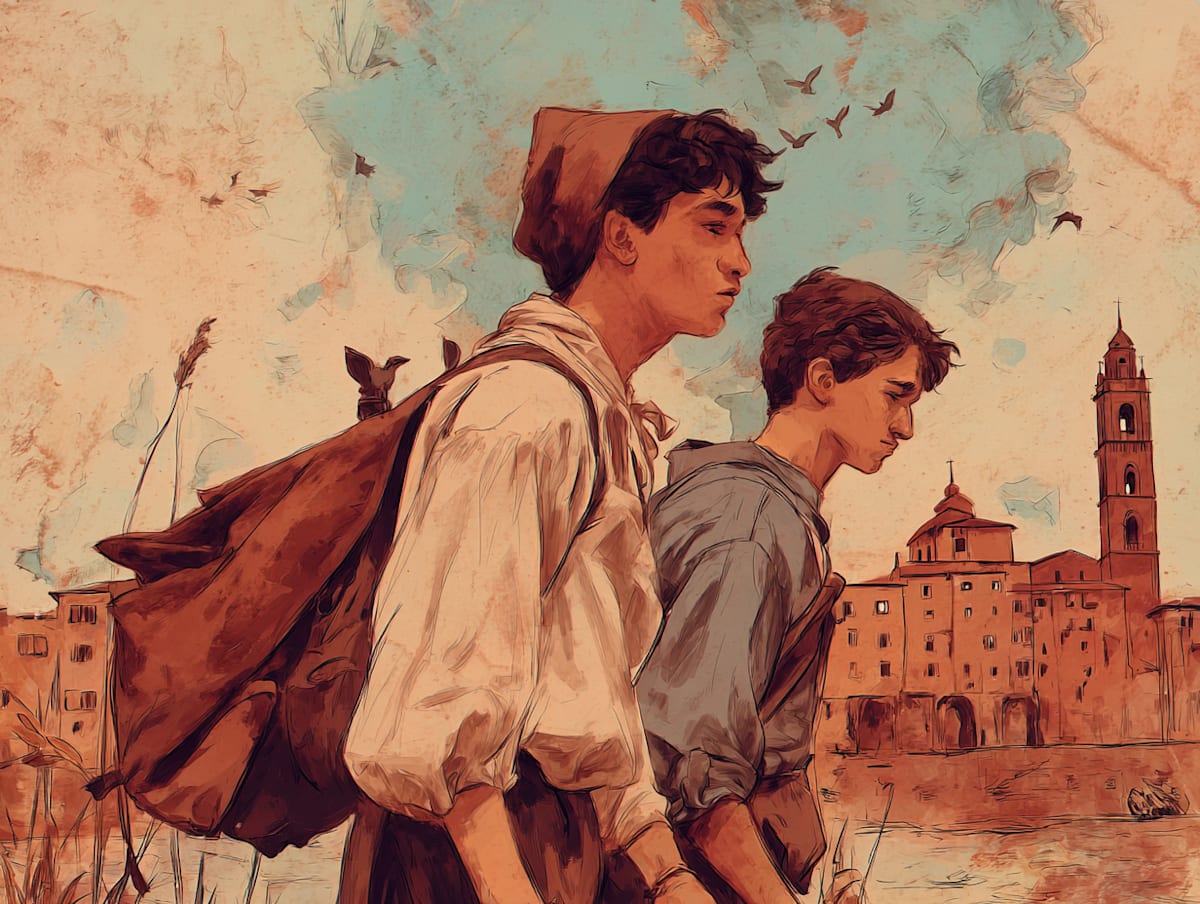
So here's Book One. Across the Arno: The Oltrarno Passages. An introduction to Graham's world — fifteenth-century Florence as seen through the eyes of his fans, his family, and the husband who will always reside in his heart.
I hope you enjoy meeting them as much as I've enjoyed writing them.
— Michael