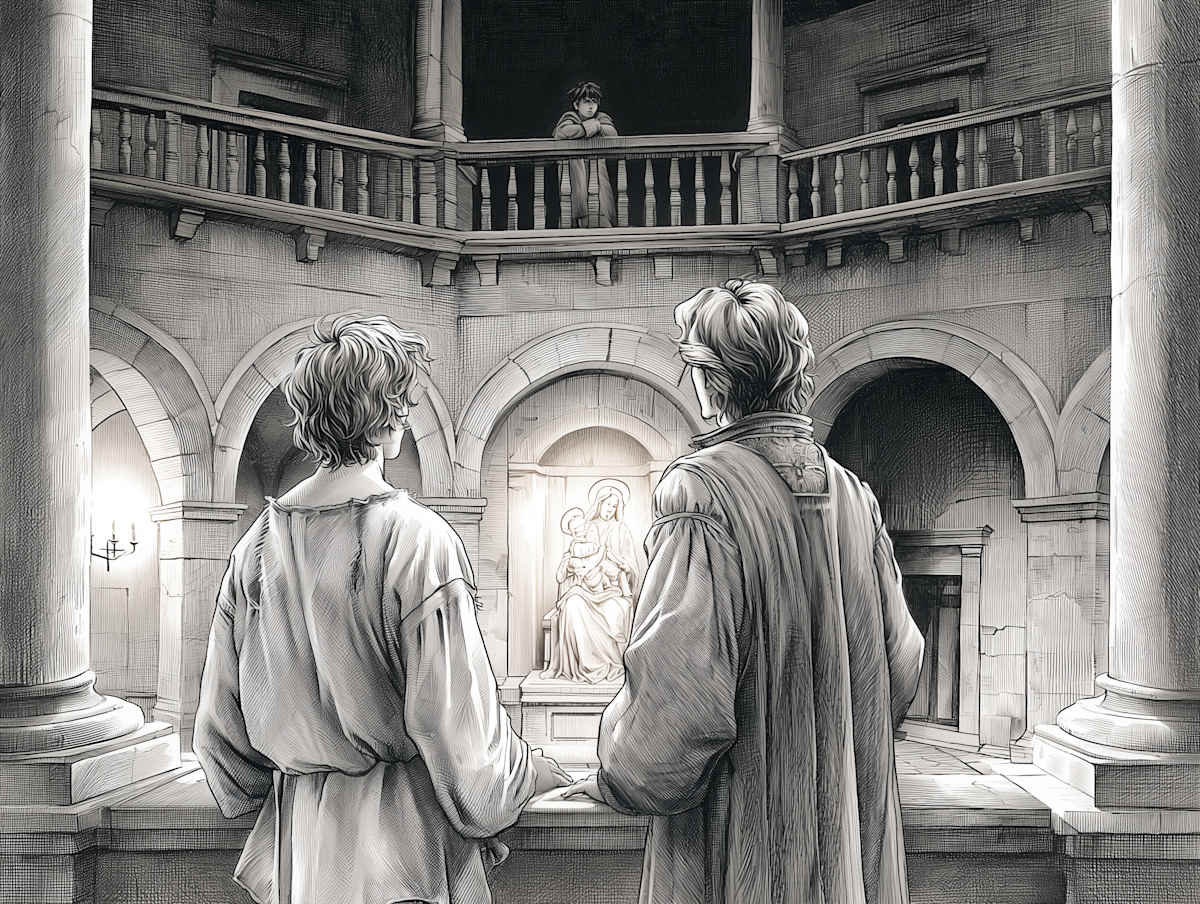
The Oltrarno Passages, Book Three
When I wrote to you at the end of Book Two, I said there was one more bank to go. This is it. The Other Shore is finished, and the trilogy is complete, and for the first time in a long while I am not carrying these people around unfinished. It is a strange lightness. I keep checking my pockets.
I want to tell you a little about where the whole thing came from. Not what happens — the book will do that better than I can — but why it exists at all.
This is the second time I've written a deaf character, and both times I was writing toward the same man. I had a boyfriend in the nineties who was deaf, and what he taught me — patiently, and also not patiently at all — is that most of communication is the willingness to be wrong about what you think you just understood. I misconstrued him constantly. He always had the perfect comeback. Snark and edge on every joke, and underneath it, the soul of a saint. Readers of these books have already met him, in a way. They just know him by a different name.
He and I had something else in common. We had each lost someone we loved to AIDS — different men, different years, the same country of living-after. I have wanted my whole writing life to get that country down on paper: not the loss itself, but what it is to keep going inside it, to make tea in it, to answer the door in it. These books are where I finally tried.
Graham exists because a nephew of mine once asked why I didn't write fantasy — dragons, wizards, the good stuff. I had no satisfying answer, so I gave the question to a fictional author and let him fail to answer it too. Some of you have asked whether Graham is me. He isn't. But his nephew's question is real, and so is what it eventually cost him to answer it.
And then there are the Oltrarno novels themselves — the books inside the books, Marco and Alessandro, Renaissance Florence, five hundred years back. People ask why a trilogy set on the coast of Maine spends so much of its time in the sixteenth century. The honest answer is that I wanted to tell one story through two lenses. Two men growing old together, at that distance, seems impossible to us. Maybe it was. I wrote it anyway, and I let a grieving novelist in Maine write it with me, and somewhere between his pen and mine it started to feel less like invention and more like restitution.
The cast of these books runs from a five-year-old with a doll to a retired man who looks suspiciously good in red. That range is not an accident. One thing I've come to believe — and the third book is where I finally said it out loud — is that regardless of age, we all live in circles: repeating the stories, the lessons, the hard-won wisdom, insisting on them for the people we love while quietly benefiting ourselves.
Which brings me to Levi.
At the end of my last post I asked you to trust the small Levi moments — to linger on them longer than you could account for. I chose the word trust very carefully, and I have waited to tell you so. Book Three is where that promise gets kept. I won't say how. I'll only say that everything I have been putting at the edge of the room since page one of Book One walks to the center of it now, and that the word I chose is the word the whole series was always about.
There is a longer note at the back of The Other Shore — the cards I couldn't lay down until you'd read the last page. I'll meet you there.
Thank you for crossing all the way over with me.
— Michael