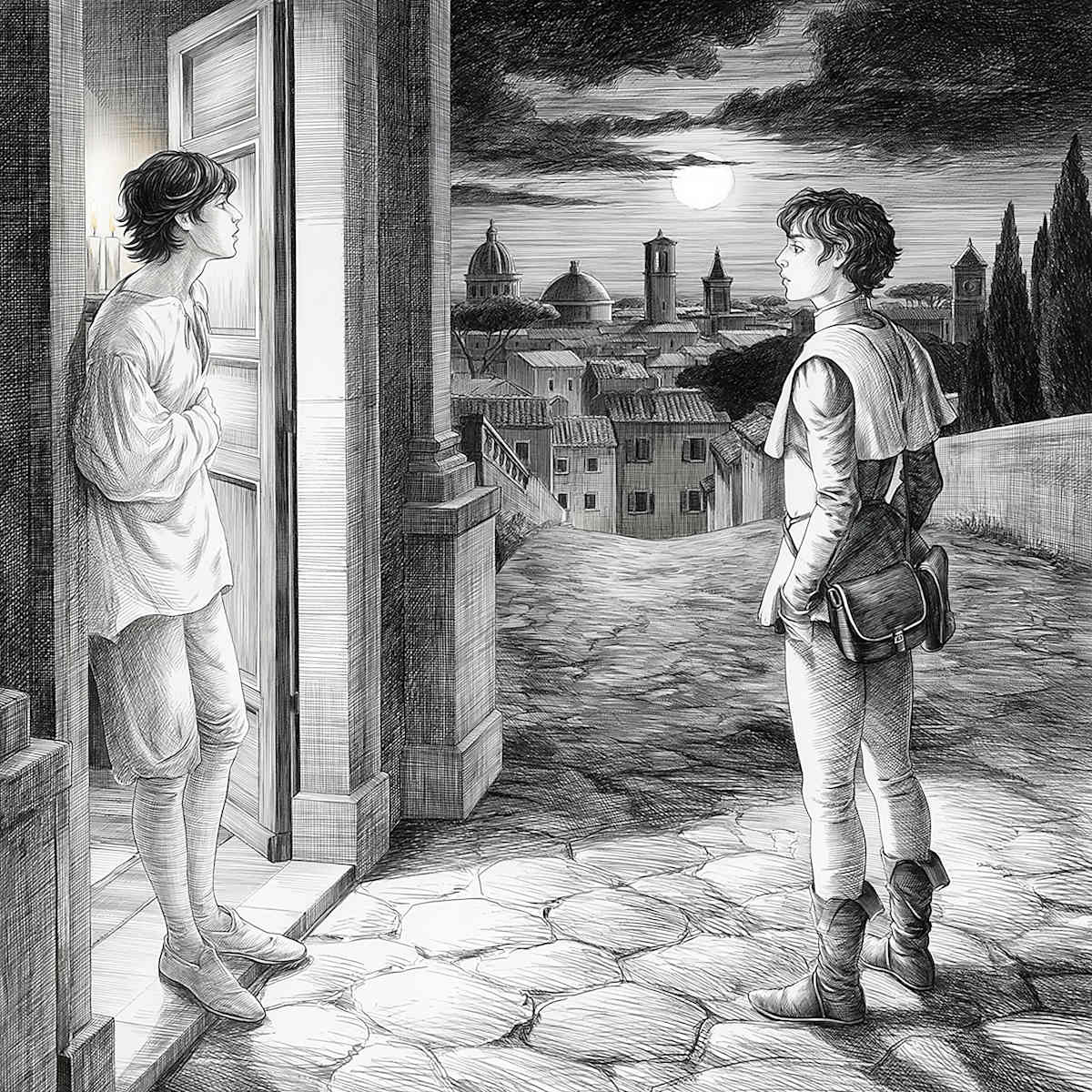
The Oltrarno Passages, Book Two
When I sat down to write Across the Arno, I knew there were three books. I knew which characters carried which volume. What I didn't fully understand — not until I was deep into Book Two — was who the trilogy actually belonged to.
I want to talk a little about that. Not enough to spoil anything. Just enough, I hope, to let you in on what I've been doing.
The Far Bank picks up where Across the Arno left it. The same town. The same grief at the edges of the same kitchen. The same Oltrarno novels sitting on a shelf, still unfinished. What changes is the angle. Book One looked through Graham's eyes — at a world that had already happened to him. Book Two looks through Eli's, at a world still happening.
And here is the thing about Eli I most wanted readers to feel this time around.
In Book One, you see Eli the way the world tends to: a young man with hearing aids, accommodating, easy, present. In Book Two, you are inside him. You see the accommodating from the other side of it — what it costs to do without complaint, the small constant translations no one ever notices because Eli has long since stopped letting anyone notice. And then, in moments I tried to write almost without comment, you get to see him not have to. A room where the noise drops away. A conversation that doesn't ask him to chase it. Signing across a quiet kitchen. Relief, briefly, made visible.
I didn't want those moments to feel like a payoff. I wanted them to feel like the air finally being the right temperature. So much of who Eli is — so much of what makes him the man other characters lean toward — has nothing to do with sound. I think Book Two is the first place the prose itself agrees with him about that.
Two other threads I'll mention, briefly.
Michael, Graham's nephew, is working out what shape his life wants to be. The shape we expect for ourselves, the one we inherit from movies and parents and the prevailing wind, is not always the one that fits us. Michael is finding that out the slow way, which is the only way it ever really happens. What I love about writing him is that the discovery is not a loss. It is a key turning in a lock he did not know he had.
And then there is Levi.
Levi is a child in these books. He stays a child. He does not carry the plot — not yet, not in the way readers are watching for plot to be carried. But he is, and has always been, what this trilogy is about. The old soul at the edge of the room. The one who notices. If you find yourself, at the end of Book Two, lingering on a small Levi moment longer than you can account for — trust that. I put it there. I have been putting them there since page one of Book One.
Thank you for crossing this bank with me. There is one more to go.
— Michael